How to set up an AI receptionist for your restaurant in 2026
An AI receptionist captures reservations 24/7, answers menu questions, and never puts callers on hold. Here's exactly how to deploy one for your restaurant — start to first booking in under 30 minutes.
If you run a restaurant, you already know the problem. Every missed call during dinner rush is a missed booking. Every late-night caller asking "are you still open?" gets voicemail. Every Sunday morning takeaway order goes to a competitor because nobody answered.
An AI receptionist fixes all three. It's a voice agent that picks up the phone, sounds like a real human, takes reservations, answers menu questions, and forwards genuine emergencies to you. It runs 24/7 for cents per minute.
This guide shows exactly how to deploy one for your restaurant — start to first captured booking in under 30 minutes.
If you just want to skip ahead and try it, sign up at Call2Me — $10 in free credits, no credit card. The setup wizard handles the prompt, voice, and language for you.
What an AI receptionist actually does
An AI receptionist for a restaurant typically handles four things:
- Reservations — date, time, party size, special requests, contact details. The booking lands in your inbox or on a webhook into your reservation system.
- Menu questions — what's on tonight, vegetarian options, allergens, prices, wine pairings. Pulled from a knowledge base you upload (a PDF of your menu works).
- Operating hours and location — "are you open Monday?", "where exactly?", "do you have parking?". Static info the agent knows because you told it once.
- Escalation — if a caller wants to complain, modify a same-day booking, or speak to the manager, the agent transfers the call or captures a callback request.
What it does NOT do well: take complex orders with off-menu modifications, handle disputes, or quote prices for things you didn't tell it about. Scope it correctly and it will run for years; over-scope it and you'll be unhappy.
Why now (and not 2024)
In 2026, three things make this a no-brainer for restaurants:
A typical restaurant getting 5 missed calls a night at an average ticket of $80 loses about $400/night in opportunity cost. An AI receptionist costs around $1-2 per captured booking. Your first weekend pays for the year.
Step-by-step setup (under 30 minutes)
1. Create your account
Go to dashboard.call2me.app, sign up with your email. You get $10 in free credits (about 60 minutes of voice — enough to test thoroughly). No credit card required.
2. Run the setup wizard
The wizard asks a few short questions:
- What's your restaurant called? ("Acme Bistro")
- What language do most callers speak? (English / Turkish / German / French / Spanish / Italian / Portuguese / Arabic — pick one)
- What should the assistant do? (reservations, menu info, hours)
- Anything special? (booking notice, cancellation policy, blackout dates)
It generates a tuned, locale-correct system prompt for you. No prompt engineering required — you can read and edit it after, but the defaults are production-grade.
3. Upload your menu (knowledge base)
Drop in your menu as a PDF, DOCX, or just paste a URL to your menu page. Call2Me's knowledge base ingests it, chunks it, and the agent picks the right pieces during the call automatically. No vector store to provision, no RAG pipeline to write.
This is what makes the agent answer "do you have anything gluten-free tonight?" correctly — it's reading your actual menu in the moment.
4. Pick a voice and pick up a number
Call2Me ships with voices from ElevenLabs, Cartesia, OpenAI, and Deepgram. Test two or three and pick the one that fits your brand. Warm and slightly chatty usually beats formal for restaurants.
Then either:
- Use the demo number for testing (free, US-based, inbound only)
- Buy a phone number ($1-3/month) in your country via Telnyx, right inside the dashboard. The agent answers it instantly.
5. Forward your existing line
You don't have to give up your current restaurant number. Set up call forwarding from your existing line to the Call2Me number — most carriers support "forward when busy" and "forward when no answer". Now your AI receptionist catches the calls you would have missed, and your existing line keeps working for the rest.
Within minutes of going live, you'll see the first captured reservation in your dashboard inbox — usually with full caller details, the time they want, and any special requests they mentioned. From here you can wire a webhook into your existing booking system (OpenTable, Resy, your own spreadsheet) so the data flows automatically.
What it costs to run
Pricing is published on the pricing page and live at GET /v1/pricing.
For a restaurant use case:
| Component | Cost |
|---|---|
| Voice base (STT + LLM + TTS + KB) | $0.10 / min |
| Telephony (PSTN inbound) | +$0.05 / min |
| Recording (optional) | +$0.05 / min |
| Typical booking call (~2 min) | ~$0.30 |
A busy restaurant fielding 100 booking calls a week pays roughly $120/month all-in. Compare to a part-time human who answers the phone for $20-30/hour and the math is clear within the first month.
What can go wrong (and how to avoid it)
This is for reservations and general info — not for taking credit card payments over the phone (use a checkout link instead) and not for handling allergies as medical advice. Keep the agent in scope.
Don't deploy a Turkish agent if you've only tested it in English. The wizard ships prompts in 9 languages, but voice quality and natural phrasing differ — call your own agent in your customers' language and listen.
Every call is transcribed and viewable in the dashboard. Spend 20 minutes reading the first week's transcripts. You'll spot one or two recurring questions the agent fumbles, and a tiny prompt edit fixes them for everyone.
Try it tonight
The fastest way to see this work is to set it up on your own restaurant before dinner service tomorrow. Even if you only forward your line during off-hours, you'll catch every late-night booking your competitors miss.
Set up your AI receptionist free →
Read next
- What is Voice AI? A 2026 field guide — the foundational primer.
- Voice AI vs IVR: which one should you actually use? — why a "press 1 for reservations" menu is leaving money on the table.
- Sub-500ms voice latency, explained in budgets — why the AI receptionist sounds human and not robotic.
Keep reading
All posts Tutorial
Build a restaurant voice agent in 10 minutes (step-by-step)
A literal walkthrough — wizard click by wizard click — to put a Turkish-and-English voice agent on a real phone number that takes reservations, answers menu questions, and forwards emergencies. From signup to first live call in 10 minutes.
Apr 30, 20265 min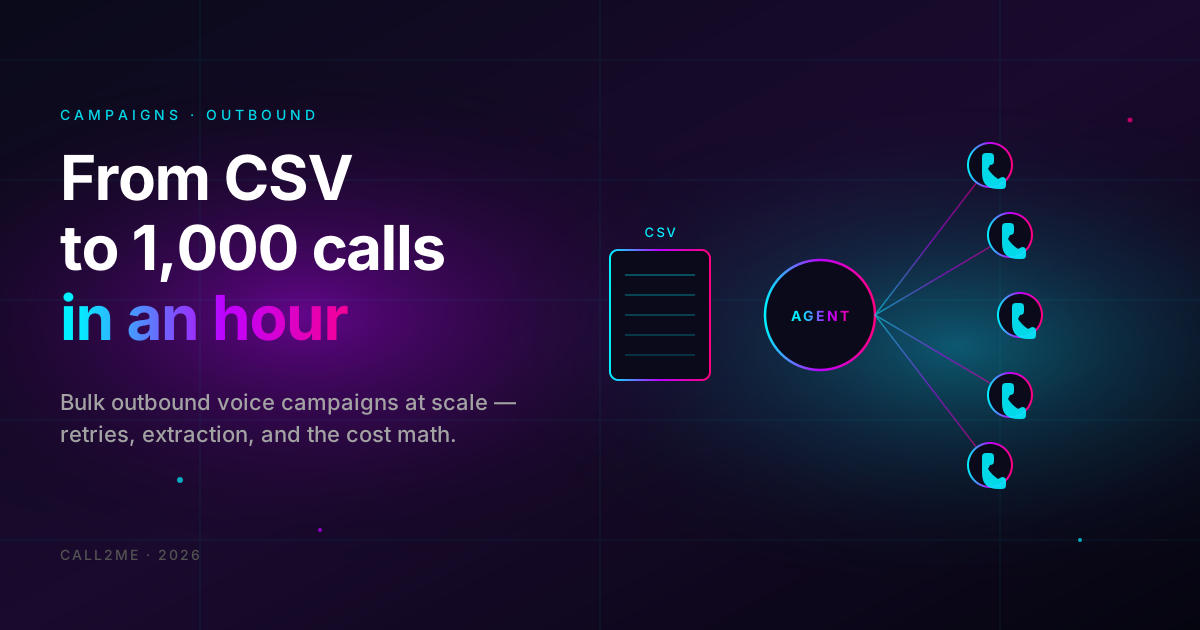 Campaigns
Bulk outbound voice campaigns: from CSV to 1,000 calls in an hour
How to run an outbound voice AI campaign at scale — CSV upload, retry rules, post-call data extraction, and the cost math that makes it work. Live and dialing in under 30 minutes.
Apr 30, 20267 min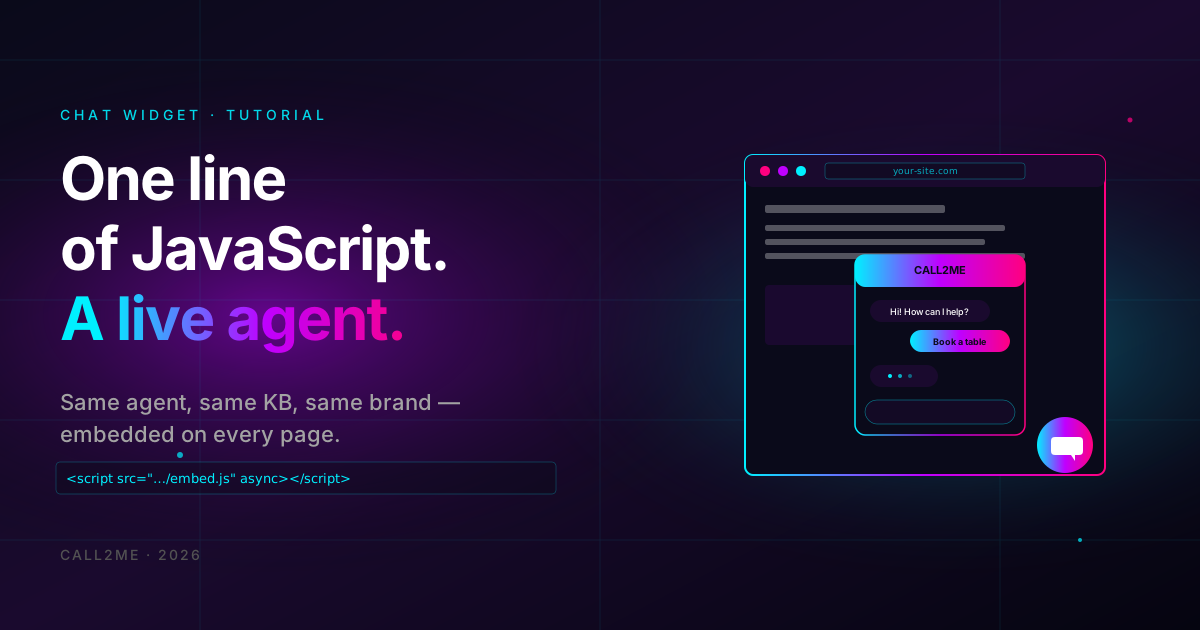 Widget
Ship a chat widget on your site in one line of JavaScript
Drop one script tag, get a live AI chat agent on every page — same agent that answers your phone, same knowledge base, same brand. The full setup, the customization options, and the pricing math.
Apr 30, 20265 min